Prompt in, video out
Videos made by AI, built with remocn.
Every video in this gallery was generated by an AI agent from a single prompt — real React components, rendered with Remotion. Each page shows the prompt, the code, and a one-command install for your own project.

shadscan — Introducing shadscan
An introducing spot for shadscan (shadscan.com) — OrcDev's deterministic UI auditor for React shadcn apps — in the site's own register lifted from the live stylesheet: pure shadcn neutral (#0a0a0a canvas, #fafafa ink, #a1a1a1 muted, hairline white/10, zero decorative chroma — the only color is terminal-semantic green/amber/red), Outfit (the site's font-heading) for every spoken headline, Nunito Sans for secondary lines, Geist Mono for the terminal and every command. Demo-loop arc: a three-beat pain escalation (It looks right / It feels done / It ships broken — 'broken' in destructive red) decays into the registry ascii-dissolve in text mode — the frame becomes a living glyph field (' .:-=+*#%@', ink on #0a0a0a with a sparse terminal-green scattering), then 'Meet shadscan' arrives as real type and the field opens a granular cavity around it (enterStyle 'clearing') — while the shipped scan-corner mark stroke-draws itself on above and the site's own H1 'Deterministic UI audits for shadcn apps' lands word by word beneath. A push-through dives into the heart: ONE continuous mac-terminal session rebuilt from the react-doctor reference — two-row chrome (traffic lights, centered window title, a named tab that flips shadscan → claude at the handoff, plus button), the one-shot command typing itself (pnpm dlx @shadscan/cli@next), a live 'Scanning components (48/48)' counter, a six-row blur-in category cascade (foundation / interaction / states / accessibility / forms / production-polish — passed in green, issues amber, accessibility red), then one finding expanding with explanation, ⟶ fix, file path, and a syntax-tinted code frame (amber line highlight, gutter '>', caret under the token) — and the receipt: '64/100 Needs work' with the amber bar animating to 64. The session continues uncut: 'Hand these findings to an agent?' — ❯ Claude Code / Codex / Copy prompt, the selector stepping and landing, the diff landing red-minus/green-plus (the aria-label fix), '✓ All findings resolved', rescan — and the score counts 64 → 100 as the bar sweeps amber to green: 'shadscan score: 100/100'. A whip-pan lands the gate: 'Same source. Same score.' over a compact terminal card typing --fail-under 80, answering 'score 71 — below the floor' and stamping 'exit 1' in red — 'Regressions don't merge.' Focus-pull into the outro: the mark + lowercase wordmark lockup, the command typing once more with a block caret, shadscan.com beneath. Terminal scroll is a step function — the buffer snaps, never glides. No swirl, no ripple, no letter-spacing, no uppercase, no badges, no pills, no installation pills, no pulsing.

remocn — Showcases: 41 videos, one camera
The announcement cut for the remocn showcases page, told as ONE continuous physics camera flight — no monitor wall, no transition-grammar cascade, a language this repo hasn't spoken before. Remocn brand register (Manrope 400, warm obsidian #141318, ink, one lime accent, Geist Mono for the section gates and featured lower-thirds) over the quiet simplex-noise void. Every one of the 41 shipping videos flies as a real screen in a 3D canyon — the actual mp4 renders frame-locked to the composition clock, walls 640×360, the three featured floats 1280×720 — so the video IS the gallery. Ignition: the opener (introducing-shadcn) lights up alone, the camera pulls back on an ease-out and the near screens burst past the lens into their slots on staggered springs while soft-blur-in lands 'Every one of these was made with remocn'. The flight: a banked weave (roll derived from lateral velocity, yaw from heading, no linear segment anywhere) through four mono family gates — the gift cuts, the sponsor spots, the changelog cuts, the product demos — with a wake that shoves each wall outward as the camera's draft passes. Three match-cut dives give the zoom language: the camera accelerates ease-in into a center-lane float until it exactly fills the frame, cuts to the same hero clip continuing fullscreen (frame-perfect both ways, the float never unmounts), a Manrope lower-third names it, then the camera pulls back as the float springs down out of the lane — introducing-shadcn, introducing-vercel, remocn-icons-3d. A whip-pan lands the count: all 41 thumbnails spring into one mosaic wall (deterministic shuffled stagger), the wall recedes and a rolling-number odometer lands on 41 — 'videos made with remocn', '22 minutes of footage, all of it deterministic'. The wild beat: 'And it's not just us' — a code-drawn card for haydenbleasel/blume (a video package built with remocn) beside mono rows of five more repos, '10 public repos already wired to @remocn'. A smoke-dissolve lands the inherited outro: the ring blooms, the R draws itself on, 'emocn' slides out from behind it, and remocn.dev/showcases rises beneath. No letter-spacing, no uppercase, no badges, no installation pills, no pulsing.

remocn — Showcases: living photographs
The showcases announcement re-told as a stop-motion scrapbook, after the paper-documentary reference: a xerox-warm desk world that moves at ten hand-placed poses per second (every transform quantized to a 3-frame stop-motion clock, stepped springs whose overshoot survives as re-shot poses, a per-pose paper wobble on every object) — while the video inside each photograph plays smooth at 30fps. That dissonance is the concept: the showcases are living photographs. Opens on a dark card where a white pen handwrites 'the remocn showcases' over the quiet grain field (Caveat laid down letter by letter, each glyph keeping its own slant and baseline wobble), then the dark page swings away like a notebook cover onto the paper desk. A polaroid stack: the top photo plays its real render full-motion inside a white paper frame, its slug is handwritten on the bottom band, then a hand flips it aside in four keyframed poses and the next photograph is revealed already playing — seven photos (introducing remocn, next.js, shadcn × react aria, icons in 3d, ai & social, prisma, introducing vercel), flipped alternately left and right into growing piles. The scatter beat deals the whole collection out across the desk while the camera pulls back a power of ten on a stepped spring; '41 videos' is handwritten large across the clean center band with a lime-ink marker stroke, and a taped paper sticker typewrites 'made with remocn · 22 minutes of footage' in mono. A page turn lands the wild: taped mono stickers for the outside repos — haydenbleasel/blume large with a handwritten 'packages/video · remotion' note and a hand-drawn ink arrow from the headline — '10 public repos ship with it too', 'wired to the @remocn registry' in pencil. The finale is drawn, not cut: on a clean page the pen draws the R letterform stroke by stroke (the shipped mark path), ink floods the glyph, 'emocn' slides out from behind it — the brand lockup, paper edition — and 'remocn.dev/showcases' is handwritten beneath with one lime stroke. Live policy: the top photo pre-warms 40 frames early and freezes on its last shown frame once flipped aside; desk photos are thumbnail stills (peak decoders ≈ 3). remocn components: shader-grain-gradient, typewriter. Caveat / Geist Mono / Manrope (wordmark only); paper #f1eee7, ink #26242c, one lime-ink accent. No letter-spacing added, no uppercase, no badges, no pills, no pulsing.

remocn — Showcases: powers of ten
The second announcement cut for the remocn showcases page, written as ONE continuous zoom of scale — not a flight through space but a single unbroken take from inside one playing video out to the whole remocn universe and back in twice, with no cut, no swap, no transition boundary anywhere in the body. Remocn brand register (Manrope 400/600, warm obsidian #141318, ink, one lime accent, Geist Mono for slugs, counts and repo rows) over a quiet grain-gradient field. Cold open: the real introducing-remocn render is just playing, fullscreen and chrome-less — you think you're watching a normal video — until the camera snaps back on a spring and it becomes a framed tile on a plane. Every camera move is an additive spring in the log-scale domain (overlapping beats stay continuous, every arrival overshoots and settles like a mass on a spring), with a sine hand-drift enveloped away inside dives and log-domain kicks when the first tiles slam in — no linear segment exists. The wall grows along an elliptical spiral in three pulls — 4, then 13, then all 41 — tiles arriving on staggered impact springs, near waves playing live then freezing on their last shown frame, the far field arriving as stills; an inline rolling-number odometer rides the third pull's caption and lands on 41 the same beat the last tile lands ('videos, made with remocn' · '22 minutes, every frame rendered from code'). Two dives give the zoom-in language: after a 3-frame anticipation breath the camera dives into the introducing-vercel tile until it exactly fills the frame — the tile has been playing its 1280×720 hero mp4 the whole time, so the dive is the same pixels continuing, physically impossible to cut — lower-third names it, spring-bounce out, dive again down the opposite diagonal into remocn-icons-3d. The widest bounce lands the wild: the wall is suddenly not alone — slabs for outside repos ring it, haydenbleasel/blume largest ('Ten public repos ship with it too', wired to the @remocn registry). Then the finale the repo hasn't seen: the zoom keeps going and every object in the universe — all 41 tiles and the six slabs — spring-flies to a sampled pad inside the R letterform (deterministic Path2D hit-test against the shipped mark path, pads matched by polar rank so neighbours fly together) while the contour draws itself around them in screen space; ink rises through the mosaic until the mark is solid, the world hands off pixel-identical to the lockup layer, the R springs down to logo size, 'emocn' slides out from behind it, and remocn.dev/showcases rises beneath. remocn components: shader-grain-gradient, soft-blur-in, rolling-number. No letter-spacing, no uppercase, no badges, no installation pills, no pulsing; numbers are plain — never a '+' suffix.
Prisma — Introducing Prisma
An introducing spot for Prisma (prisma.io) — agent infrastructure for TypeScript — in the site's own current register, tokens lifted from the live stylesheet: #131420 canvas, #f9fafb ink, the ORM indigo ramp #6366f1 / #818cf8 and the Prisma Postgres teal #14b8a6 / #2dd4bf, Inter carrying everything (the site's UI face) with Geist Mono in the code register. The official press-kit mark + wordmark paths (public/prisma), animated as the logo being written before it is seen: the prism contour and inner facet stroke-draw on, the official fill rises beneath and the stroke thins away, then the wordmark glyphs dock in from the right one by one. One continuous paper.design gem-smoke field — a new remocn component, smoke living inside the official prism silhouette, indigo-to-teal — carries the whole video behind a vignette, its intensity scored from the root: bright for the reveal, dimmed under code, wide open for the outro. The signature cut is prism-refraction, another new remocn component: a beam of white light strikes the prism outline, the indigo-to-teal spectrum fan swallows the outgoing scene, then the fan folds back the same way it opened — the wedges closing into a thin ray pointing right, the exact reverse of the entrance — and the beam exits right while the prism spins once and glides into the incoming scene's own mark slot: the refracting element becomes the logo, never hidden and re-shown — used exactly twice, the opening turn and the final stamp. Arc: a pain conveyor (Raw SQL strings / No autocomplete / Schema drift — every line arrives from the right, exits left) → refraction into the reveal → the site's own 'Agent infrastructure for TypeScript' → the signature mechanism: 'Define once — generate the client', schema.prisma cascading line by line, npx prisma generate flashing, the generated client materializing with its ': User[]' editor inlay hint → whip-pan montage of five statement-first stations: Type-safe queries as a live autocomplete menu, Typed relations (the new relation-graph: User and Post cards, the @relation curve draws itself, a pulse rides it), Declarative migrations applying themselves, Every database as the provider rolodex (postgresql through cockroachdb, the quote hugging each name), and Browse your data (the new prisma-studio: rows populate, a record is typed in, Save presses itself to ✔ Saved) → platform lines (Start with the ORM / Add Postgres / Deploy on Compute) → a plain 47,300 GitHub stars count-up → the getting-started hook to action: a terminal card types npx prisma init and npx prisma generate with the real CLI answers, then yields the frame to 'Start at prisma.io' → the lockup alone on the open smoke field, prisma.io faint beneath. Motion grammar: enumeration always travels left, narrative turns are branded refractions or push-through dives, calm shifts are crossfades and focus-pulls. No letter-spacing, no uppercase chrome, no badges, no eyebrows, no installation pills, no pulsing, no glow halos.
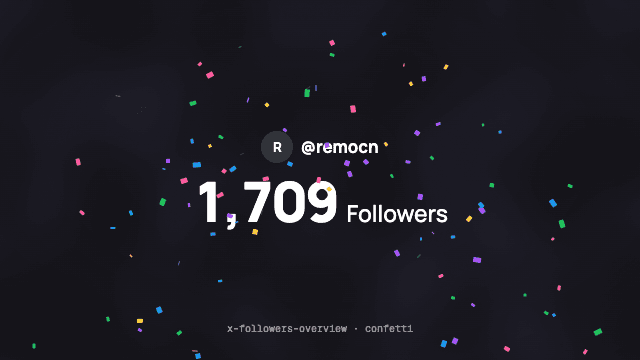
Changelog — AI chat simulators and social cards
The changelog cut for the 2026-06-17 'AI chat simulators and social cards' entry, made for the changelog page itself. Built on the entry's own opening sentence — two shots show up in almost every launch video, someone prompting an AI and a follower count going up — so the video names shot one, plays it five ways, names shot two, plays it through to the confetti, then closes the loop: now both of them are components. Remocn brand register (Manrope 400, warm obsidian #141318, ink, one lime accent, Geist Mono for the surface captions and the shell command) over the introducing-remocn simplex-noise field. Every surface in the release performs for real: Claude Code, Claude Chat, ChatGPT, OpenCode and v0 type themselves out in a five-beat hard-cut montage, then the X Follow Card takes its click and the X Followers Overview cycles its notifications while the total climbs, firing its own confetti the frame the number lands. Every component keeps its own brand — Anthropic clay on both Claude surfaces, OpenAI's dark composer, OpenCode's blue, v0's monochrome, X's blue on both social cards and the overview's own confetti palette — because being recognizable is the point of a branded simulator; what holds the montage together is the obsidian field they share, the identical framing and the one mono caption beneath each, not a colour wash. No accent prop is overridden anywhere. The single intervention in the whole video is legibility: chat-gpt is hardcoded to its light theme, so that one beat runs invert(1) hue-rotate(180deg) — the classic dark-mode pair that flips luminance and puts the hues back — and it reads as ChatGPT's own dark surface instead of a blown-out light one. Debuts the NEW composer-send registry transition — the cut IS a prompt being submitted: the outgoing scene contracts rect-to-rect into a centered composer pill as if the whole frame were the thing you just typed, the pill holds with a lime caret while the prompt line fills, the send control fills lime and the pill presses 8px down and releases, then the pill expands back out to full frame and the incoming scene resolves inside it through a top-down streaming wipe, the way a response arrives. It carries the two boundaries that mean 'the prompt was answered' — into the AI montage and out of it — and everywhere else is crossfade or blur-crossfade, per the house grammar. Closes on the payoff assembling word by word, a three-line value block, a typed npx shadcn add @remocn/ whose slug rolodex-flips through the whole release, and the introducing-remocn outro inherited with the new logo: smoke ring, the R mark drawing itself on, 'emocn' sliding out from behind it. No swirl, no ripple; no letter-spacing, no uppercase, no badges, no eyebrows, no pulsing, no installation pills; every offset on the 8px grid.
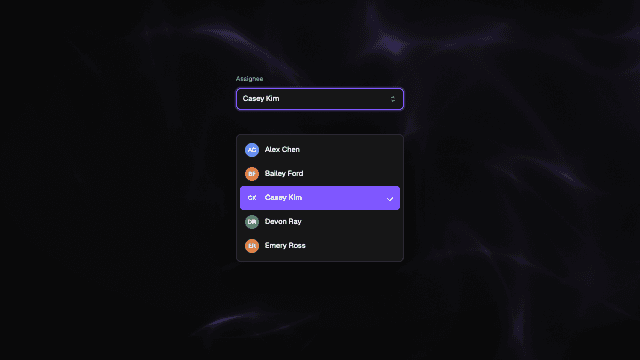
shadcn/ui × React Aria — Choose your foundation
The announcement cut for shadcn/ui's July 2026 changelog entry: React Aria is now a first-class component base alongside Base UI (still the default) and Radix (still supported). Register sampled live from ui.shadcn.com's dark tokens on 2026-07-17 (#0a0a0a canvas, #fafafa ink, #171717 card, #a1a1a1 muted, hairline white/10, radius 10, Geist 400 + Geist Mono) with React Aria as the guest brand: its exact header mark (single two-subpath purple path, light-dark #6733FF/#7F57FF — dark side used) and Source Sans 3, Adobe's open face, standing in where the guest speaks. Debuts the NEW shader-caustics registry component: a custom raw-WebGL field of refracted light — the caustic web light makes when it passes through a surface and lands on the floor beneath, denser toward the bottom of the frame (the base, rendered literally) — whose filaments take a violet undertone the moment the aria base is chosen and never give it back. Opens wordless: a shadcn/create fragment where the Base list holds two rows (Base UI · Default, Radix) and a third rises into it from below carrying the exact aria mark — React Aria — then the violet focus ring, React Aria's own signature, springs onto the new row, a check draws in, and the camera dives into the committed choice. One camera the whole way: beats enter from below and exit upward on springs, sections dive forward through the remocn push-through, no lateral travel anywhere. Both logos are exact and animated in the lockup — the canonical shadcn mark (icons.tsx, two round-cap diagonals, strokeWidth 32) draws itself stroke by stroke while the aria mark traces its outline and fills bottom-up — under 'React Aria, now a base'. The mechanism is one typed mono line, pnpm dlx shadcn@latest init --base aria, verbatim from the changelog, with the ring springing once around aria and holding; then one real button proves the base's three powers as the claims swap overhead in React Aria's own hero words — it presses itself on 'Built-in behavior', the ring lands on it for 'Top-tier accessibility', and its label re-types through Save → Enregistrer → 저장 for 'Internationalization, out of the box'. The eight style names (Vega, Nova, Maia, Lyra, Mira, Luma, Rhea, Sera) assemble as a hairline 4×2 grid under 'All eight styles.', the calm reassurance lands (Base UI stays the default, Radix stays supported), and the stamp: both marks return small, settle side by side, and 'Choose your foundation.' resolves over a faint ui.shadcn.com — the site's own tagline ('The Foundation for your Design System') answered in one verb. No swirl, no ripple; no letter-spacing added, no uppercase, no badges, no pulsing, no installation pills; every spacing on the 8px grid.
Changelog — The remocn agent skill
The changelog cut for the 2026-06-25 'The remocn agent skill' entry, made for the changelog page itself. Remocn brand register (Manrope 400, warm obsidian #141318, ink, one lime accent, Geist Mono for the agent prompt, catalog rows and shell command) over the introducing-remocn simplex-noise field, with a faint /remocn › terminal chrome top-left the whole way — the video is one prompt being answered. BAB arc built on the changelog's own hinge, 'stops being a guessing game': the ask types itself ('make me an intro scene'), the agent used to guess (wrong tries — blur-in? fade? …slide? — churn in a mono slot), then the NEW catalog-riffle registry transition debuts — the cut IS the agent thumbing the catalog: mono component rows riffle past, a lime cursor decelerates and snaps onto one row, and that row grows (rect-to-rect) into 'The remocn skill'. The mechanism lands as three mono catalog rows (which components exist / what each one is for / how to compose them), then the payoff pays off the hook: the same prompt now composes a real scene — a framed mini-intro assembling while the components that built it tick in (scale-down-fade, shader-warp, logo-enter). A second catalog-riffle lands 'Works with your AI', where the AI-company marks (Claude, OpenAI, Cursor, Grok) spring in through the shipped logo-enter component — the skill runs inside whichever agent you use. The install-all improvement is shown as one action — a lime Install all button lands and a check sweeps every row — then a line-by-line value block (your agent builds with remocn / a catalog it can read / the code is still yours), a typed npx skills add Remocn/remocn (the slug in lime, a terminal line, never a pill), and the introducing-remocn outro inherited with the new logo: smoke ring, the R mark drawing itself on, 'emocn' sliding out from behind it over remocn.dev. No swirl, no ripple; no letter-spacing, no uppercase, no badges, no pulsing, no installation pills.
reui — Say hello to my new sponsor
A sponsor spot for reui (reui.io) — Keenthemes' design-forward, open-source shadcn/ui component library — in reui's own register lifted straight from its token file: pure monochrome neutral, zero chroma (dark theme bg oklch(0.145 0 0) ≈ #0a0a0a, ink #fafafa, card #1a1a1a, muted #b5b5b5, border white/10%), Inter 400 for everything (the site binds --font-sans and --font-heading both to Inter), Geist Mono for the one shell command, over a quiet grayscale simplex-noise field pushed back by a vignette. The accent is white — reui keeps color inside its own charts, so the spot does too. Follows the sponsor-cut arc: the family hook 'Say hello to my new sponsor' rises word by word; a push-through lands the lowercase reui wordmark resolving out of depth with 'Design-forward shadcn/ui components' beneath. Debuts the NEW icon-scatter registry transition (not swirl, not ripple): the scene shatters into a deterministic field of line-icons that stroke-draw, spin and scatter outward over a cover that hides the swap, then fly off and draw away as the next scene resolves through them — motion-forward, self-contained, citing reui's 500 animated icons; the scattered icons settle into the icon wall it lands on, eighteen real registry icons stroke-drawing and firing their action in a diagonal wave under 'Icons that animate on their own'. The reui wordmark is the real inlined logo (the rounded-square mark with its R swoosh and dot, beside the lowercase 'reui'). A focus-pull into the live demos — hard-cut one per beat: a Data Grid dealing rows in with a sort caret and a selected row, a Kanban card lifting out of To do into Doing, and an animated bar Chart. Then the five Pro-block groups are named one word at a time through the shared-axis-z depth morph — Application → Solutions → eCommerce → Data Grid → Marketing, each held to read — before the Pro-blocks showcase lands: a category grid rebuilt from reui.io/blocks where twelve cards (Dashboard, Chart, Auth, Kanban Board, Data Grid, Settings, CRM, Product Card, Stats, Analytics, Billing, Timeline) deal in on a diagonal wave, each carrying a tiny live preview of that block type inside (bars, a drawing line, a form, columns, table rows, toggles, a list, a product card, a stat, a timeline). reui is free at its core (1,019 components) with a paid Pro tier of 485 blocks. The 2026 line 'Your agent can build with them too' (reui ships an MCP server) soft-blurring in, then a typed npx shadcn@latest add reui.io/r/ whose component slug rolodex-flips through data-grid → kanban → stepper → timeline → calendar (a terminal line, never an install pill). Closes on the introducing-remocn logo gesture inherited: a smoke ring blooms, the R mark draws itself on, 'emocn' slides out from behind it to assemble the Remocn wordmark, then a hairline and '✕' beside the real reui logo fade in beneath as the sponsor credit. No swirl, no ripple; no letter-spacing, no uppercase, no badges, no pulsing, no installation pills.

Scratch — big-type jitter check, round two (the ground)
A scratch diagnostic reel, not a shipping cut. Round one varied the entrance over a flat background and nothing trembled, so this one inverts the experiment: every band runs the same real SharedAxisZ word morph at the same 86px over the same 2% push-in, and only the ground under the type differs — 1 live noise (the sponsor-reui backdrop exactly, the simplex field at speed 0.32 under its vignette, repainting every frame), 2 flat black (the field removed), 3 frozen noise (same field and texture, speed 0, never moves), 4 live noise with no entrance (the moving field under a word that hard-cuts in and then sits perfectly still). Each band is a window onto a full-size replica of the scene, offset so every band shows the same central strip the real word stands on.

Scratch — big-type entrance jitter check
A scratch diagnostic reel, not a shipping cut: the sponsor-reui group-word morph run four times at once, one per band, each in its own promoted zoom layer so no band can disturb another. The bands differ only in how the entrance treats geometry — 1 as shipped (the real SharedAxisZ, scale 0.9 to 1 on a deep ease-out whose last frames creep by hundredths of a pixel), 2 short tail (same entrance, but the scale lands on 1 early and stops while opacity and blur keep running), 3 opacity only (the word never changes size, so nothing moves sub-pixel), 4 hard cut (no entrance, the control). A hairline under each word is the reference: it is geometry, so it glides no matter what, and letters shimmering against their own hairline is the artifact under test.

Scratch — chat transition candidates
A scratch comparison reel, not a shipping cut: four identical takes of the chat-changelog turn (the pain exchange → 'Chat components'), one per bubble-bloom variant — bloom (the typing pill itself inflates into the next scene), pop (the bubble overshoots and bursts, the scene lands on the pop), launch (a sent bubble flies up from the composer and unfolds), send (no bubble: the thread scrolls up and the scene springs in from below) — each take labeled in mono bottom-left.
Scratch — ascii-dissolve enter styles
A scratch comparison reel, not a shipping cut: five identical takes of the llms-txt turn (verdict → ascii-dissolve cover → headline), one per enterStyle of the ascii-dissolve transition — clearing (cells near the text vanish first), halo (a soft dark well grows around the text), wave (one density impulse rides outward from the text), focus (the field defocuses while the sharp text resolves), lime-echo (a sparse accent ring flashes once) — each take labeled in mono bottom-left.
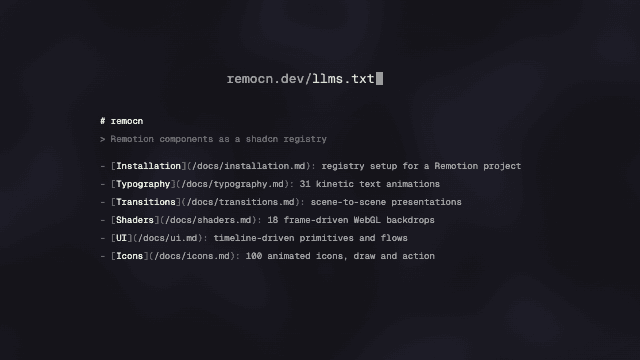
Changelog — llms.txt for AI agents
The changelog cut for the 2026-07-06 'llms.txt for AI agents' entry, made for the changelog page itself. Remocn brand register (Manrope 400, warm obsidian #141318, ink, one lime accent, Geist Mono for URLs, markup noise, and the index/corpus text) over the introducing-remocn simplex-noise field. BAB arc: a direct-address hook ('Your agent reads the docs too'), then the pain shown from the agent's eye — a clean docs sentence buried alive by mono markup fragments crowding in from all four edges until the entry's own verdict lands over the dimmed soup ('A bad way to learn an API'). The turn debuts the NEW ascii-dissolve registry transition in its text mode: the verdict blurs out as a fullscreen glyph field rises cell by cell — a deterministic noise flow driving each cell through the density ramp (' .:-=+*#%@') — and holds fully readable as pure plain text; then 'Now the docs are plain text' arrives as real type and the field clears from the text outward (enterStyle 'clearing': the per-cell dissolve order is biased by distance to the headline's letterform mask, sampled once from the real fonts on an offscreen canvas, so the nearest cells vanish first and a granular cavity opens around the arriving type) — no ascii preview of the incoming text, no flat fades: the cut IS the release, rendered pixels becoming text becoming the next scene. Three route beats on one mono surface: remocn.dev/llms.txt types itself (filename in lime) and the real index pours in line by line — paths with one-line descriptions; the filename rolodex-flips in place to llms-full.txt and the whole documentation streams past as one Markdown document; then a real docs URL takes the slot, '.md' types itself keystroke by keystroke, and the rendered docs card flips to its raw Markdown source on the last key. The ascii cover's second pass carries the surface away into line-by-line values (one index / one full corpus / every page in Markdown) and the introducing-remocn outro inherited with the new logo: smoke ring, the R mark drawing itself on, 'emocn' sliding out from behind it. No swirl, no ripple, no skeleton-swap; no letter-spacing, no uppercase, no badges, no pulsing, no installation pills.
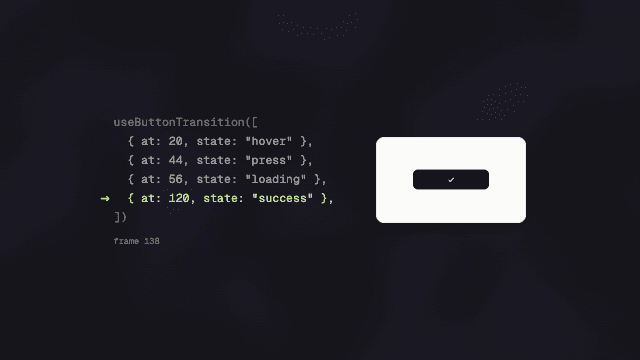
Changelog — remocn/ui arrives
The changelog cut for the 2026-06-12 'remocn/ui arrives' entry, made for the changelog page itself — remocn's UI-primitives tier shown ACTING on camera. Remocn brand register (Manrope 400, warm obsidian #141318, ink, one lime accent, Geist Mono for the steps array / frame counter / shell command, Inter bound inside the product surfaces) over the introducing-remocn simplex-noise field. PAS arc with a demo-loop core: a ticker hook cycles the three un-fakeable shots (a dialog opening / a menu filtering / a form filling itself) into 'Every demo has to show the product', two pain lines split the changelog's own argument at its hinge (real components run on the clock / a video only has a frame number), then the NEW skeleton-swap registry transition debuts — the cut is a loading state: the outgoing scene collapses into skeleton placeholder blocks, one lime shimmer sweeps across, and the blocks hydrate into 'Meet remocn/ui'. The spine is a comparison-split: a mono useButtonTransition steps array reveals line by line while a REAL Button walks hover → press → loading → success as the playhead passes each `at`, the active step reading in lime and a mono frame counter ticking beneath. The demo run pays off the hook on the changelog page's own surface: the command menu (vendored from the registry) springs open on a beat, the query types 'pub' and the list filters live per character, the highlight settles on Publish changes, a press lands it, the menu closes and a success toast slides in. A five-beat breadth montage hard-cuts live primitives on small light stage cards — checkbox checks, switch flips, tabs slide, select opens, toast lands — each with its mono name; line-by-line values (around forty primitives / assembled flows included / deterministic on every render), a typed npx shadcn add @remocn/command-menu with the package in lime, and the introducing-remocn outro inherited with the new logo: smoke ring, the R mark drawing itself on, 'emocn' sliding out from behind it. No swirl, no ripple; no letter-spacing, no uppercase, no badges, no pulsing, no installation pills.
Next.js — Introducing Next.js
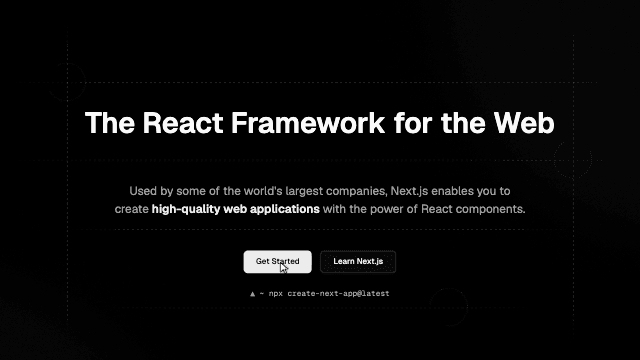
An introducing spot for Next.js — Vercel's open-source React framework — a gift video for a giant the viewer has heard of, where the job is not awareness but crystallization. Strictly monochrome in the nextjs.org dark register (#000000 canvas, #111111 card, #ededed ink, #a1a1a1 muted; white is the accent), Geist 400–600 with Geist Mono only for the shell register, one grayscale grain-gradient field carrying the whole video. It opens on the eclipse: the backlit Vercel triangle over a grainy halo (a grain field masked to a circle of light), 'You've already used Next.js today.' beneath — then the camera dives INTO the triangle, its flat black swallows the frame, and we fall through a giant grain ring (the introducing-videorc signal dive, in grayscale) onto the official full logotype WRITING itself: each glyph of the shipped 394×80 brand SVG traced by its outline with the fill rising beneath the tracing line, starting exactly as the tunnel hands the frame over. The nextjs.org hero rebuilds around its own construction furniture — the intro-module dashed guides drawing in and the 75×75 dashed marker circles settling on their intersections with a barely-there dash drift — headline verbatim in Geist 600, the subtitle with its bold segment kept bold, the Get Started / Learn Next.js pair, and '▲ ~ npx create-next-app@latest' beneath; a push-through lands the receipts marquee (Nike, Notion, Audible, The Washington Post, Sonos — verbatim from the featured customers). Then the three feature cards rebuilt live as whip-pan stations: Built-in Optimizations (the mountain photo re-assembling from pixels at 1440px and 375px, a shine developing each), Dynamic HTML Streaming (the wireframe app streaming in piece by piece on its dashed grid while the shipped blue pulses travel the wires), and React Server Components (the sphere tree growing node by node, two spheres wearing the wireframe mesh). The Powered By circuit lights up — the chip's traces draw outward to the React / Turbopack / Speedy Web Compiler cards and colored light pulses ride the wires (illustration-surface colors, the same exemption class as code syntax). The numbers land in Geist 600 tabular odometer digits — 0.09 layout shift (Notion) wheeling down, 100 ms to respond (Frame.io) wheeling up, both verbatim from nextjs.org — a grayscale grain cover marks the install, npx create-next-app@latest types itself alone, and the blueprint lockup closes the loop: dashed construction lines, marker circles on the far intersections, the circle-N with its official gradient sheen beside 'Next.js', nextjs.org beneath, the grid breathing. GitHub stars deliberately absent. No letter-spacing, no uppercase, no badges, no pills, no pulsing, no decorative glows.
Vercel — Introducing Vercel
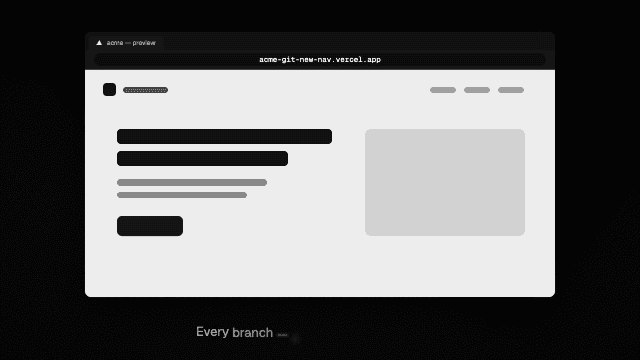
An introducing spot for Vercel — the platform Next.js ships from — flown as ONE continuous camera flight with no hard cuts: the triangle is a portal, every scene change is a seamless zoom into a triangular opening that contains the next world, and the flight's three stations are Vercel's own creed. Register sampled from vercel.com + the official OG hero: #000000 canvas, #ededed ink, #fafafa bright ink reserved for the creed and lockup, #a1a1a1 muted, #111111 card, Geist 400–600 sentence case with Geist Mono only for shell commands and URLs-as-chrome. Shipped fully monochrome per the spec's own fallback — Vercel blue #0070f3 was not verifiable against their live design-system tokens at build time. One 3D void carries the whole video: pure black with living film grain (shader-grain-gradient in near-black grays) and a grayscale light source — the OG eclipse rebuilt live as shader-god-rays behind a black triangle occluder, the only sanctioned lighting event. The flight: the eclipse and 'Shipping used to be the hard part.', then the camera accelerates INTO the triangle (NEW triangle-portal: the outgoing scene scales past the lens while a polygon clip-path opens from the flight target) into the DEVELOP world — a terminal alone in space, git push typing itself; the camera dives into the terminal's block cursor, whose rectangle becomes the browser viewport in one continuous match-cut (NEW seamless-zoom: rect-to-rect infinite zoom, the API takes target rects, not magic numbers) — the PREVIEW world: a clean browser card on #111111, an acme-git-new-nav.vercel.app URL in the address bar, a comment pin popping onto the page; the camera flies into the triangular favicon in the browser tab — the favicon IS the triangle — into the SHIP world: the same page multiplying outward across a receding field of edge-node dots on a perspective plane, a latency figure wheeling down from 240 to 38 ms in the corner of the formation. Then the pull-back: the Ship world recedes onto the front face of a slowly rotating 3D triangular prism whose three faces are the three worlds just visited (NEW prism-spin: preserve-3d prism, faces host arbitrary scene children, rotation is a prop) while 'Develop. Preview. Ship.' builds word by word in bright ink, each word landing exactly as its face passes. The prism recedes into the grain; the agent era lands as four sliding lines (AI SDK. / Sandbox. / AI Gateway. / Infrastructure for agents, too.), the receipts land with figures wheeling into place — 100 million monthly visits (Zapier) and millions of agent chats daily (Notion), both verbatim from vercel.com's customer strip at build time — and the camera drifts back to where it started: the backlit triangle, now near, shrinks into the lockup slot as 'Vercel' slides out from behind it, 'Where the web ships' and vercel.com settle beneath, and the rim light breathes once and holds. No letter-spacing, no uppercase, no badges, no pills, no pulsing, no decorative glows beyond the eclipse exemption.
shadcn/typeset — Introducing shadcn/typeset
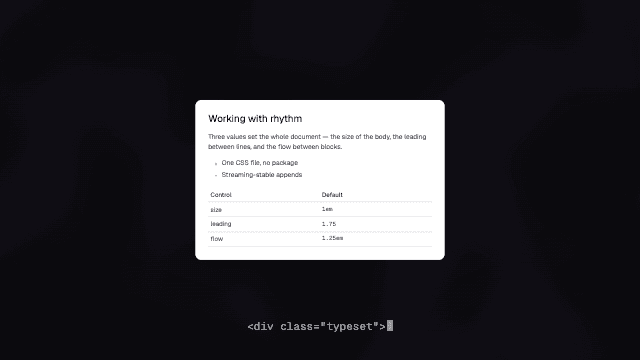
An introducing spot for shadcn/typeset (July 2026) in the same monochrome register as the introducing-shadcn gift cut: zinc-950 canvas, ink #fafafa, Geist 400 only, no letter-spacing, no uppercase, no pills, no badges, no links on screen; color lives only inside the muted plum/rose shader covers, over one quiet simplex-noise field. The video IS typography — the product demonstrates itself. Hook: five hard beats where each word is set as the element it names (Headings as an h1, Paragraphs among greeked body bars, Lists on a bulleted row, Tables inside ruled cells, Code on its own line inside a small numbered code block). The pain: 'You've styled them for the blog' with the key word rolodex-flipping in place (blog → docs → chat), then the docs' own words — 'Every time, the same fight — sizing and spacing'. A muted-plum smoke-ring cover — deliberately not the swirl of the earlier cuts, and rhyming with the outro — lands 'Meet shadcn/typeset', the site's tagline glides in, and the centerpiece: a real markdown document rendered in raw browser defaults (Georgia, cramped leading, default table borders) sits on a white page while class="typeset" types itself beneath — and on the closing quote the document BREATHES into set type: a FLIP morph where the letterforms dissolve Georgia → Geist fast while leading and flow open up slower, the spacing visibly doing the work. The same document then glides left as a .typeset CSS rule slides in — a code block in the docs' own register (near-black panel, warm tan values, gray punctuation) — and the three rhythm values flip in place one at a time — --typeset-size bumps and the document scales, --typeset-leading opens the lines, --typeset-flow spreads the blocks — resolving on 'We call it rhythm'. A dusty-rose dither lands the context montage: the SAME document reshaping per preset in three hard cuts — .typeset-docs (sidebar chrome, 13.5px, tight flow), .typeset-chat (inside a dark chat bubble, following the smaller type around it), .typeset-reading (the one serif moment: Lora 17px, airy leading). Then the 2026 differentiator: 'Built for streaming' → a chat reply streams in markdown block by block (heading, word-by-word paragraph, list items, a mono class chip) with every earlier block holding pixel-still as each new block adds its own space below → 'New blocks land — earlier ones never move'. A line-by-line pillars block (Container-aware / Theme-native / Zero specificity), 'And the file is yours', and a smoke-ring outro with the shadcn/typeset name over 'One CSS file you own.' (no URL).
remocn icons — Introducing remocn icons (3D gallery cut)
The third cut of the remocn icons announcement: the exact same eight scenes, copy, and transition grammar as the main cut — the motion-vs-stillness hook pair, the bell reveal, the kinetic positioning, the ten-icon morph run, the rolodex install, the rebrand lockup — but the gallery beat is opened into real depth with @remotion/three. The whip-pan lands INSIDE the set — on a detonation: all 24 icons burst out of the center like shards, each rebuilt as a true tube stroke — its registry path sampled along its length and swept into a TubeGeometry, so the icons stay made of the same stroke material as everywhere else in the video, just given volume. Every shard leaves the blast on its own beat, tumbling on all three axes, and traces its stroke on MID-FLIGHT — fast and front-loaded so the burst is recognizable from its first frames (setDrawRange walks each tube exactly like a dashoffset walks an SVG stroke, subpaths sharing one draw clock proportionally to their length) — then decelerates into its grid slot with a hair of overshoot, the spin unwinding into a resting tilt, until the debris resolves into a three-layer parallax field with no overlaps. The camera takes the blast as recoil, pushed back with a decaying shake, then a whisper of drift keeps the layers sliding. A white key light from the front and one lime rim light from behind-left (the accent living in the light, not on the strokes) shade the ink tubes; once landed, every icon floats with a quiet deterministic sway — the wall ripples alive, now in parallax. The exit echoes the blast: the caption fades and the camera accelerates THROUGH the wall over the last ~0.8s — the front layer rushing past the lens into a near-dark frame — so the hard cut into the morph run lands mid-dive and inherits the speed. And the outro answers the gallery by being staged entirely in 3D: the R is an extruded beveled solid from its first stroke — a 3D tube traces the letterform while the camera holds a three-quarter view, the body fades in beneath the tracing outline with its volume already showing and the lime rim resting on its side faces, then one deliberate arc swings the camera into dead face-on, landing with zero velocity exactly as 'emocn' slides out from behind the mark. Depth is read by parallax and traveling light, never by a maneuver; the canvas never unmounts, so nothing flashes. Once the lockup settles, one glossy white sheen — a highlight with subtle dark shoulders, synchronized in screen space across the 3D mark and the DOM tail — crosses 'Remocn' as the sign-off. The icons got volume mid-video; the mark is born with it. The scene runs 36 frames longer than the flat cut to give the dolly room; everything else — the neuro-noise field, the obsidian register, the anti-slop rules — is inherited unchanged.
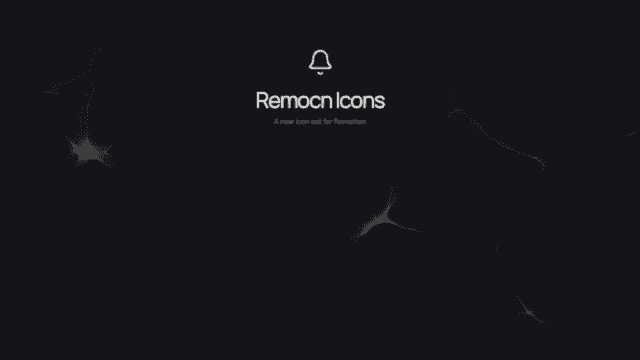
remocn icons — Introducing remocn icons (one-take cut)
The second cut of the remocn icons announcement: the exact same eight scenes as the main cut — the motion-vs-stillness hook pair, the bell reveal, the kinetic positioning, the 24-icon gallery wave, the ten-icon morph run, the rolodex install, the rebrand lockup — but with the entire transition grammar removed and replaced by ONE continuous camera drive across a monitor wall. The whole video is one huge flat canvas: all eight scenes stand side by side as 1280×720 tiles with a 150px gap, laid out as a snake (right, right, down · left, left, down · right). Nothing fades and nothing reveals — every scene is always there. The camera sits perfectly still on a tile while its scene plays (zoom exactly 1, pixel-crisp), then pulls back to 0.62, glides to the next tile on an eased 28-frame move and settles in; pan and zoom have zero velocity at every joint so the drive never judders, and a whisper of screen-speed motion blur rides the glides. The wall is alive: each scene starts playing 34 frames before the camera lands — mid-glide the next monitor is already waking up — and finished scenes keep standing at their last frame, so every pull-back shows the previous video resting beside the next one running (the two hook lines even share a frame mid-glide). The neuro-noise field stays pinned to the lens and the wall slides past over it. Same remocn brand register, same copy, same anti-slop rules; roughly 45 seconds because travel time is part of the language.
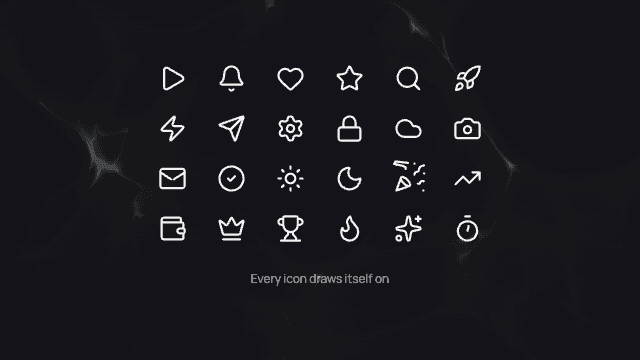
remocn icons — Introducing remocn icons
The announcement of remocn's first sub-project: remocn icons — 100 Lucide-derived icons re-authored from scratch as animated, deterministic Remotion components (stroke draw-on + a choreographed action per icon, built on @remotion/paths). Remocn brand register (Manrope 400, warm obsidian #141318, ink, one lime accent, Geist Mono only for icon names and the shell command) over one neuro-noise shader field — a web of fine living strokes, the same material the icons are made of, never used as a carrier before — recolored into the obsidian family with a faint lime undertone and pushed back by half opacity and a vignette. The hook is a grammar joke: 'Everything in your video moves' resolves character by character out of blur (the lushest entrance remocn ships), then a quiet crossfade lands 'Except the icons' — and nothing else happens: no easing, no life, three frozen gray outlines beneath it; the stillest frame in the whole video. A push-through dives through the dead icons into the reveal: one huge bell stroke-draws itself on alone, gets its grand beat, rings once, then glides up and shrinks as 'Remocn Icons' resolves tight beneath — the product demonstrates itself before it is named. Kinetic '100 Lucide icons, rewritten for video' (plain number, no suffix), a whip-pan onto a 6×4 gallery where 24 real registry icons stroke-draw in a slow diagonal wave and then each fires its own action so the wall ripples alive. Then the spine of the video, one unbroken shot: 'Then it acts' lands, and ONE continuous lime stroke draws on as the heart and morphs through ten icons via interpolatePath, ordered by silhouette similarity so each shape flows into a neighbour — heart beats, flame flickers, moon rocks, cloud drifts, bubble bounces, shield thumps, bookmark dips, star twinkles, zap flashes, play presses — each station's mono name crossfading beneath, every little action easing out of rest and hand-written on the raw paths, not registry code; on the final hold the claims land: 'The paths land in your repo' / 'So you can write motion we never shipped'. Install: a typed npx shadcn@latest add whose lime package name rolodex-flips through icon-folder → icon-tag → icon-filter → icon-sparkles — four icons the morph run did not use, fourteen distinct icons across the two scenes — while the drawn icon above morphs in sync, flip and morph the same beat. Outro inherited from the rebrand video: the R letterform stroke-draws on at cap height, fills beneath the tracing outline, and 'emocn' slides out from behind it as the outline thins away, remocn.dev faint beneath. Scene changes are push-through, crossfade, whip-pan, and focus-pull, plus one hard cut into the morph run — no swirl anywhere, no line-by-line-slide anywhere. No letter-spacing, no uppercase, no pills, no badges, no plus-suffixes, no trailing periods.

remocn — A new logo
The rebrand announcement for remocn's new logo — the R letterform on its black plate — told the only way remocn could tell it: the logo is written before it is seen, and once drawn it never cuts. Remocn brand register (Manrope 400, warm obsidian #141318, ink, one lime accent, Geist Mono for the code register) over one deep-blue paper.design warp field (checks shape, the #000d14 → #005285 family, swirl 0.55 with 13.4 iterations) pushed far back by half opacity and a vignette so it never competes with the mark. Hook: two scale-down-fade lines — 'remocn needed a new logo' / 'So we wrote one'. The writing: the logo's SVG source types itself out under a faint filename tag — the black plate rect, then the real path data in lime, closed by a block caret. A push-through dives INTO the code and the same d attribute stroke-draws itself as the ink R, large and alone; then the whole rest of the video is ONE morph shot: a single tile carries the mark through every surface, physically transforming between shapes — it rounds into the black circle avatar of the REAL @_remocn X profile page, rebuilt element for element from the live account (top bar with back arrow and 61 posts, the warp field itself as the banner behind a Remocn lockup, Edit profile, the 'Under review' seal pill, bio, the briefcase/pin/link/calendar meta row, 1 Following · 540 Followers, the Posts tab underlined in X blue) — every element rising in a calm top-to-bottom cascade around the landed tile; glides left and squares into the org avatar of the real GitHub header (Remocn, 'Remocn. Write code. Get videos', the full followers/Ukraine/remocn.dev/X-handles/mail meta row staggering in item by item); shrinks to a sixteen-pixel favicon inside a browser-tab fragment, and finally grows back to center where the black plate dissolves and the bare R stands at cap height — 'emocn' slides out from behind it, together assembling the remocn wordmark (the intro outro's own gesture, inherited), dead-centered and alone — no tagline, no URL, nothing else on screen. The montage rides under a pinned 'One mark, everywhere' line; the chrome of each surface rises in and sinks out around the tile, never over it. One accent, no glow, no confetti, no trailing periods.

tenkit — Introducing tenkit
An introducing spot for tenkit, the generator for Expo projects that ship as multiple branded native apps from a single shared codebase, in the product's own register lifted from tenkit.dev: #09090b canvas, #fafafa ink, Space Grotesk (the site's font-heading) for everything spoken, Inter small print, Geist Mono for config and CLI — plus the site's own THREE tenant accents (blue #208AEF, orange #EF8520, teal #2DD4A8), used only as tenant identity, never as decoration. One quiet paper.design voronoi field carries the whole video — one continuous surface partitioned into many cells IS the product — and the statement transition is the SAME shader re-lit in the tenant tints, its cells growing over the cut (apps multiplying). No swirl anywhere. The motion score is one → many: division moves outward from center, narrative progress dives into the frame (push-through), enumeration travels left (whip-pans), and the outro reverses the split. Statement-first rhythm throughout — wherever a label would sit under a visual, the words land FIRST, alone and readable, and the visual acts them out afterwards. Hook: 'One codebase' lands word by word, holds a full breath, then the line itself fans into three copies — blue rises, orange holds center, teal descends. Reveal: the real logo's two folded faces glide together out of blur, one crisp grandeur beat, then a single descent walks the mark into a BOXED lockup — the wordmark letters stand exactly as tall as the mark and 'Ship one Expo app as many branded apps' spans exactly the lockup width beneath. Kinetic 'The setup you actually ship', then the three real Setup Types hard-cut on a beat — White label apps / Runtime tenant app / Generic + standalone. Money shot in two beats: the bloom lands on 'Same code, different identity' alone; the words lift away and the screens act it out — one neutral code-drawn phone rises, two clones slide out from behind it, then identity floods left to right: icon chip, app name (Atlas / Ember / Mint), primary button re-tint per tenant. Features: three whip-pan stations, each label first at center then gliding down to its seat as the fragment arrives — a variants.config.ts with each tenant hex wearing its own color, the repo's real local CLI (pnpm tenkit build / doctor / reset), and EAS build rows filling to quiet checks. A typed pnpm create tenkit@latest alone on screen, and the outro: three tenant dots converge back into the mark slot — many apps, one codebase again — with tenkit.dev faint at the bottom. No letter-spacing, no uppercase, no pills, no badges, no highlight markers, no trailing periods.

Videorc — Introducing Videorc
An introducing spot for Videorc, OrcDev's open-source Mac studio for recording, multistreaming and AI publishing, in the product's own dark zinc register lifted from videorc.com's .dark tokens: #18181b canvas, #f5f5f6 ink, #a1a1a8 muted, and ONE accent — record-red #ff3b30, the color of the logo's eyes and the record dot. Manrope 400 throughout, Geist Mono only for the timecode chrome. One quiet paper.design grain-gradient (corners shape — film grain lives at the frame edges, the center stays clear for type, zinc family with a faint warm-red undertone) carries the whole video behind a vignette; the statement transitions are the SAME shader in its other shapes — a brand-red ripple-zoom dive and a zinc wave-wipe swell — so backdrop and cuts speak one language. No swirl anywhere. From the reveal onward the spot wears the product's own chrome: a mono timecode with a blinking red dot ticks along the bottom-left, freezes solid at the outro lockup, and lifts away — the video was one recording session. Hook: the ● REC lockup lands dead-center — the dot blinking on the camcorder cycle, REC in heavy red beside it — then the camera dives INTO the dot (an accelerating zoom pinned to the dot's center, letters flying past) until the flat red swallows the frame and dissolves into the grain-ripple tunnel already open beneath it, holding readable while it keeps zooming — the record dot IS the transition. Reveal: the tunnel reveals only the cyber-orc mark, enlarged and alone; it shrinks to lockup size and 'Videorc' drives in from the right, physically pushing the mark left into the lockup (rigid-body push, impact pop), 'The future of video starts here' rising word by word beneath. Then the three jobs hard-cut on a beat — Record / Stream / Publish. Positioning: kinetic 'Everything you need in one window'. Features: three whip-pan stations arriving from the right and decelerating — a code-drawn capture surface (red dot + running mini-timecode, camera bubble, breathing mic waveform, 3840×2160 · 60 fps), a multistream fan (the red source dot emitting five rays to YouTube / Twitch / X / RTMP / one more), and the AI publish checklist (Transcript, Title & description, Chapters, Highlights settling with quiet checks). Values: three lines via line-by-line-slide. Lockup: the site's own app icon (the orc on its black plate) + Videorc, centered alone, 'Open source, built by OrcDev' faint at the bottom. No letter-spacing, no uppercase, no pills, no badges, no highlight markers, no trailing periods.

remocn ✕ Shadcn UI Kit — New sponsor
A partner-level sponsor announcement for Shadcn UI Kit, the dashboards-templates-components kit for shadcn/ui, in its own register lifted from shadcnuikit.com: dark #0a0a0a canvas, #fafafa ink, the indigo #6366f1 hero accent, Cal Sans headings over Inter body — the site's own font faces. One persistent paper.design warp shader (edge shape, swirl 0.86 with 7 iterations, recolored into the kit's indigo family #a5b4fc / #312e81 / #0a0a0a) carries the whole video behind a vignette, every scene riding a slow camera drift. Hook: 'Say hello to my new sponsor' via soft-blur-in. Reveal: the rounded-square mark redrawn in code (five diagonal round-cap strokes measured off the shipped logo) draws itself on while the ink Shadcn UI Kit wordmark resolves out of depth, 'Launch your projects faster' settling beneath. What's inside: three hard-cut stations, each acted out inside a tiny code-drawn fragment of the kit — a mini admin dashboard assembling (sidebar rows, counting stat cards, growing chart bars, a self-drawing indigo donut), a bento of blocks snapping in tile by tile, and the theme generator re-tinting the same surface live as the accent flips indigo to emerald to amber with a hopping swatch ring. Kinetic bridge: 'Copy, paste, ship' via kinetic-center-build. Value stack: four lines via line-by-line-slide. Proof: a plain 780 components count-up (no plus-suffix). CTA: 'Your next dashboard is already built'. Lockup: Remocn ✕ the mark + Shadcn UI Kit glide together from both sides, centered, nothing else on screen. No letter-spacing, no uppercase, no pills, no badges, no pulsing, no trailing periods, compact spacing. Scene changes are push-through, focus-pull, and crossfade.
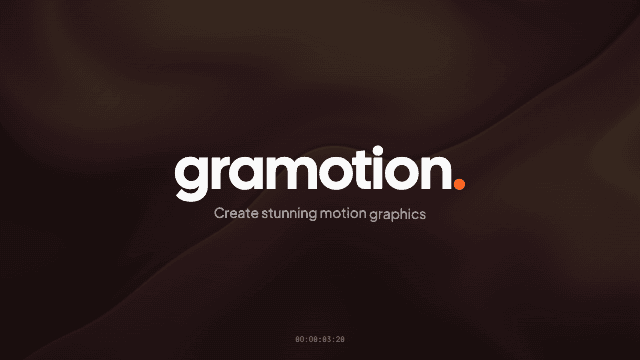
remocn ✕ Gramotion — New sponsor
A partner-level sponsor announcement for Gramotion, the browser-based motion graphics tool, in its own dark register: #0a0a0a canvas, #fafafa ink, the single orange accent #ff6825, Cal Sans headings over Plus Jakarta Sans body with JetBrains Mono for the timeline register. One persistent paper.design warp shader (checks shape, the warm #3c1515 / #944752 / #ffc085 family) carries the whole video behind a vignette, every scene riding a slow camera drift, and a quiet mono timecode ticks along the bottom edge — the spot wears the product's own editor chrome. Hook: 'Say hello to my new sponsor' via soft-blur-in. Reveal: the lowercase gramotion wordmark resolves out of depth, its orange dot springs in last, 'Create stunning motion graphics' settles beneath. How it works: the site's three-step flow hard-cut into three beats — Design / Animate / Export — each acted out inside a tiny code-drawn fragment of the Gramotion editor (shapes dropping onto a canvas with a cursor landing a handled selection frame, a timeline where the cursor drags the orange animation bar under a sweeping playhead, an export progress bar resolving into shipped mp4/gif files). Value stack: four feature lines via line-by-line-slide. Proof: a plain 1,200 waitlist count-up (no plus-suffix). CTA: 'Be there at the first frame'. Lockup: Remocn ✕ gramotion glides together from both sides, centered, nothing else on screen. No letter-spacing, no uppercase, no pills, no badges, no pulsing, no trailing periods, compact spacing. Scene changes are push-through, focus-pull, and crossfade.
remocn ✕ Canadian AI — New sponsor
A sponsor announcement for Canadian AI in their light editorial register — the only light sponsor spot in the collection: paper-white #FCFBF9 canvas, black ink, one amber accent #F59E0B (the site's Start-button color), Inter paired with Playfair Display serif italics, over a warm paper-grain gradient washed back toward the center. Every scene rides a slow camera drift. Intro: the real canadian-ai.ca swirl mark stroke-draws itself on in ink and the fill resolves. Hook: 'Say hello to my new sponsor' via soft-blur-in. Reveal: the Canadian AI wordmark resolves out of depth with the 'Operating System for Organizations' tagline settling tight beneath in serif italic. Beats: the site's own 'What we build' list hard-cut into three numbered slots — 01 Core / 02 Sales Agent / 03 Dev Agent — amber serif numerals over ink product names. Philosophy: 'Better tools create more value.' as a Playfair italic statement. Lockup: Remocn ✕ Canadian AI glides together from both sides, centered, nothing else on screen. Scene changes are push-through, crossfade, and focus-pull.
shieldcn — Introducing shieldcn Plus
The launch video for shieldcn's accounts-with-sync release: Pro collapsed into a single Plus tier ($10/mo) for maintainers who live in their READMEs. Announcement-cascade arc mirroring the author's launch tweet, in the shieldcn register (zinc-950, ink, Geist, badge-value green #22c55e) over a monochrome paper.design warp backdrop (checks shape, quiet zinc grays). Opens on a camera-glide hook where a README assembles itself from REAL shieldcn.dev renders (graph header, xs badges, star chart, sponsor wall), then a shared-axis 'This is shieldcn' education beat, the news (accounts — with sync, a self-drawing green sync arc), the free-forever reassurance with a green marker sweep, and the Plus lockup with the repo's real shield icon stroke-drawing itself on. Four feature beats — a rolling 75 saved READMEs over a mini-README dashboard grid, a saved badges library shelf dropping the same real badge into three README rows, a mass-migration PR cascade over six mono repo rows, an AI prompt typing itself into a real acme header + branded badges — then the crown: one managed brand, where the accent hex flips in place (#22c55e → #8b5cf6 → #f59e0b) and every real artifact (header, badges, chart — all fetched from shieldcn.dev with color= params) re-renders simultaneously. A quiet 'Plus keeps the lights on' beat, and a CTA with price, shieldcn.dev/pricing, and the launch20 code. Transitions are the shieldcn family grammar only — squeeze, pill-iris, zoom-blur, crossfade; no swirl, no dither covers.
shadcn/ui — Introducing shadcn/ui (gift cut)
A gift video for shadcn — an introducing spot for shadcn/ui in shadcn's own monochrome: zinc-950 canvas, ink #fafafa, Geist 400 only (font-normal forced on every embedded component), no letter-spacing, no links on screen. Color lives only inside shader covers, sampled from shadcn's X avatar and heavily muted (deep plum, dusty rose), plus one deliberate burst: the Colors beat's full Tailwind palette. Opens on a camera glide — no pull-back — across a dense 4-column masonry wall of REAL shadcn/ui components rendered live via Tailwind in the Remotion pipeline (the ui.shadcn.com homepage cards: create account, move goal with mini bars, chat, calendar with a fixed deterministic today, command menu, payment, cookie settings, team, report an issue, share, upgrade plan). A muted-plum shader-swirl cover lands 'This is shadcn/ui', a short-slide-right tagline, the creed in two beats (Not a component library → kinetic 'How you build your own'), then a real-UI category montage (Blocks dashboard cards / a live monochrome bar chart / a dark→light→dark theme flip / the full Tailwind palette grid, 22 ramps × 11 shades waving in), a line-by-line pillars block, a typed npx shadcn add with a 3D component-name rolodex, a presets suite ('Your whole design system, one preset' → the ui.shadcn.com/create builder as a settings tile stack whose Style/Base Color/Theme/Font values flip one by one while a live sign-in card reshapes — Lyra sharpens corners, Stone warms grays, Dark inverts, Geist Mono swaps type — condensing into --preset a1Dg5eFl → the same card re-theming live as the preset code rolodexes through npx shadcn init --preset → 'Switch it any time'), 'And the code is yours', a 1,000,000-apps-every-month count-up in Geist tabular figures, a Startups/YC/Fortune 500s hard-cut montage resolving on 'Everyone is building with it', the opportunity line, the 'The best part? Everyone needs UI' kicker, and a smoke-ring outro with the wordmark over 'Open Source. Open Code.' (no URL).
remocn ✕ OrcDev — New sponsor
A sponsor announcement for OrcDev in the 8bitcn register: black canvas, the paper.design dithering shader exactly as its dots/random preset (#000000 back, #008000 dots, size 5.2) pushed back by a vignette, Geist Pixel Square headlines over Geist Sans small print, and the orc-skin green #8ec71e sampled from the avatar as the only accent. Every move is quantized into sprite poses — stepped snaps, hard cuts, and green dither-dissolve covers, no blur glides. Intro: the orc nod gif crunched into chunky pixels inside an 8bitcn corner-notched frame. Hook: 'Say hello to my new sponsor' snapping word by word. Reveal: the avatar in a pixel frame, 'OrcDev' typed on with a solid green block caret, 'Web dev warrior' beneath. Beats: Build / Break / Conquer hard cuts, the last in green. Flagship: 8bitcn/ui with its real tagline and an HP bar that takes three chunky hits — Critical hit. Lockup: Remocn ✕ OrcDev with orcdev.com.

remocn ✕ react-bits — New sponsor
A cinematic sponsor announcement for react-bits over a persistent paper.design dithering shader (warp shape, 4x4 Bayer) recolored into the react-bits brand palette — #060010 landing background, #5227FF signature violet — pushed back by a vignette. Manrope 400 throughout, every scene riding a slow camera drift. Hook: 'Say hello to my new sponsor' lands word by word in the react-bits split-text register. Reveal: the white react-bits wordmark resolves out of depth with the tagline settling beneath. Proof: a plain 130 count-up (their own signature animation, no plus suffix), then the tagline cut into rhythmic hard-cut word beats — Free / Customizable / Animations for / Text / Backgrounds / UI, all in ink. Lockup: Remocn ✕ react bits glides together from opposite sides. Scene changes are push-through and focus-pull.
Changelog — Eleven New Transitions
An update announcement for remocn's eleven new transition presentations, told through self-demonstration: after the announcement beat, every scene change in the video IS one of the new components. Remocn brand register (Manrope 400, warm obsidian #141318, ink, one lime accent): two scale-down-fade pain lines (everyone animates their scenes / nobody animates the cut), a short-slide-right 'Introducing Remocn transitions' with the meta promise beneath, then the labeled cascade — whip-pan, push-through, focus-pull, a lime dither-dissolve, wave-wipe, grain-dissolve, ripple-zoom (transparent frame landing on the ripple field), warp-dissolve, perlin-dissolve, smoke-dissolve, and a lime-banded swirl-dissolve as the statement finale. A reused focus-pull enters the line-by-line value block (frame-driven, deterministic, lands in your repo), a whip-pan up enters the kinetic 'Any cut, one command' with npx shadcn add @remocn/whip-pan, and a push-through lands the camera on the Remocn lockup at remocn.dev, crediting Paper's shaders.
remocn — Introducing remocn (shaders cut)
The first-post introduction video for the remocn X account, told entirely in the library's own shaders and typography. BAB arc in the shipped remocn.dev brand (Manrope, warm obsidian #141318, one lime accent) over one quiet simplex-noise field that carries the whole video: two scale-down-fade pain lines, a shader-swirl cover (fade in → 500ms opaque hold with a slow twist unwind → fade out) into a short-slide-right 'Meet remocn', a scale-down-fade tagline beat (Cinematic video components for React), a kinetic-center-build 'Like shadcn/ui, for video', six registry categories hard-cut across fullscreen shaders (color-panels, warp, mesh-gradient, voronoi, metaballs, god-rays), a line-by-line value block (110+ components / one command / the code is yours), a typed npx shadcn add, and a smoke-ring outro where the inverted play-bars mark and lowercase wordmark assemble over remocn.dev. Scene changes are held shader covers — swirl and lime simplex dither.
remocn ✕ shieldcn — New sponsor
A sponsor announcement for shieldcn in its zinc + badge-green register, over a slow god-rays shader spotlight. Intro: a real stars-shieldcn badge springs in, centered, with a gentle float. Hook: 'Say hello to my new sponsor' resolves via soft-blur-in. Main: the Remocn ✕ shieldcn lockup assembles — the wordmark slides in, a cross fades between, the green shield-check chip springs into a ringed circle with the shieldcn name settling beside it. Finale: the badge ballet — ten real badges resolve out of blur + opacity onto a slowly winding circle, take one full turn, fall into a row, and ride off-screen, closed by the shieldcn.dev tag.
remocn ✕ Paper — Introducing shaders
A launch spot for remocn's new shader components, built on Paper's freshly open-sourced WebGL shaders. Manrope over a shader-grain-gradient backdrop: a blur-out-up hook (Paper just open-sourced their shaders), the Remocn + Paper lockup assembling around the Paper mark, a short-slide-right 'Introducing remocn shaders', then twelve shaders rendered fullscreen and hard-cut one into the next — mesh gradient, warp, liquid metal, god rays, neuro noise, voronoi, dot orbit, metaballs, water, spiral, dithering, pulsing border — pure and unlabeled. Line-by-line feature claims (18 shaders on the GPU, frozen to the current frame, deterministic on every render), a kinetic 'Any shader, one command' with the shadcn install line, and an outro where shader-swirl's twist animates 0 → 1 to wind the scene open before the Remocn wordmark resolves, crediting Paper.
shieldcn — Everything for your README
A product demo for shieldcn, the shields.io alternative that renders README badges, charts, and headers as real shadcn/ui components. BAB arc in the shadcn zinc register plus the badge-value green: a short-slide-right hook (someone just opened your repo), the dated pixel-badge wall as the pain, a three-beat shared-axis-z intro (Meet → the lockup with a self-drawing shield mark → the creed), section titles as their own interstitial beats, the five variants / sizes / icons grid, a live star-history chart with headers & sponsor walls, the `npx skills add jal-co/shieldcn` agent skill in a terminal, proof pills (MIT, Vercel OSS Program) with a rolling 500+ star count, and a drawn shield-mark lockup CTA at shieldcn.dev.
remocn ✕ LN — New sponsor
A three-scene sponsor announcement over the bg.png backdrop. Intro: an animated emoji springs in, centered, with a gentle float. Hook: 'Say hello my new sponsor' resolves via remocn's soft-blur-in typography. Main: the Remocn ✕ LN collab lockup assembles — the Remocn wordmark slides in, a cross fades between, the LN avatar springs into a ringed circle with a soft accent halo, and the LN name settles beneath.
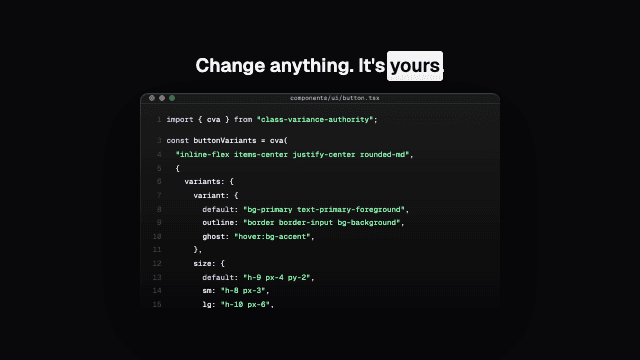
shadcn/ui — Not a library. Your code.
A product demo for shadcn/ui in its own monochrome zinc register — Geist Sans + Geist Mono, hairline grid on a zinc-950 canvas, white marker highlights. BAB arc: a ticker hook reframes 'a component library? a package?' into 'No — it's your code', the pain of fighting an installed black box, then Introducing shadcn/ui (Open Source. Open Code.), a terminal `npx shadcn@latest add button` landing the file in your project, the button.tsx cva variants in a glass code block ('change anything, it's yours'), four pillar cards (Open Code, Composable, Themeable, AI-Ready), shipping your own via `npx shadcn add @acme/card`, rolling-number proof (100,000+ stars, 20,000+ projects across Next.js/Vite/Remix/Astro/Laravel), and a wordmark CTA with `npx shadcn@latest init` → ui.shadcn.com.
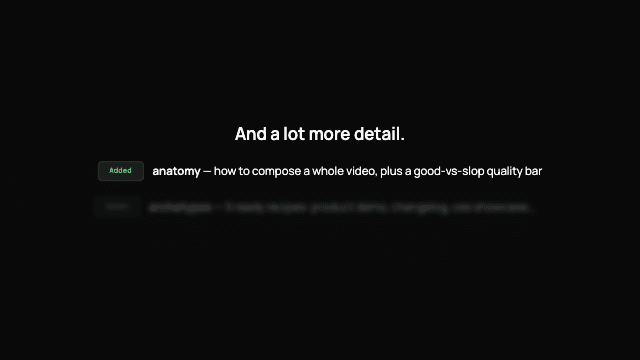
Changelog — The remocn agent skill, rebuilt
A meta changelog about the remocn agent skill itself. The skill went from one monolithic SKILL.md to a structured reference: the hero beat builds the skill's file tree (SKILL.md + references/ → anatomy, design, motion-principles, anti-patterns, archetypes/, components/), then a changelog-style list lands what was added (anatomy with a good-vs-slop quality bar, 9 archetype recipes, one-file-per-component docs), rolling-number proof (124 components, 9 archetypes, 5 guides), and a calm 'remocn' wordmark outro. A fresh warm-accent doc/IDE aesthetic on a flat near-black grid — distinct from the other demos.
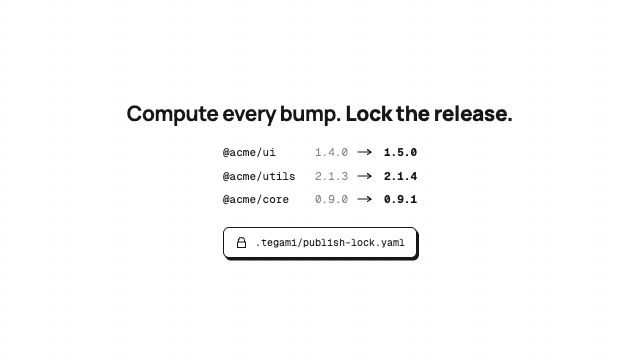
Tegami — Releasing, as simple as writing a note
An introducing demo for Tegami (手紙), a tool to manage changelogs, versioning, and publishing in monorepos. Rendered in the brand's monochrome ink-on-paper, hand-drawn world — black ink on white paper, sketch doodles, the てがみ mascot, handwritten Caveat annotations. BAB arc: release-day chores pile up, the old fixes (a brittle script, Changesets' walls) break, then Meet Tegami — a script you own (scripts/tegami.mts), write a change like a note in .tegami/, tegami version computes bumps and writes the publish lock, merge the Version Packages PR and it ships with GitHub releases, one pipeline across npm/Cargo/PyPI, retry-safe + pluggable + programmable, your AI agent writes the changelog, migrate from Changesets, and a 'record your changes!' CTA at tegami.fuma-nama.dev.
Fonttrio — Three fonts. One command.
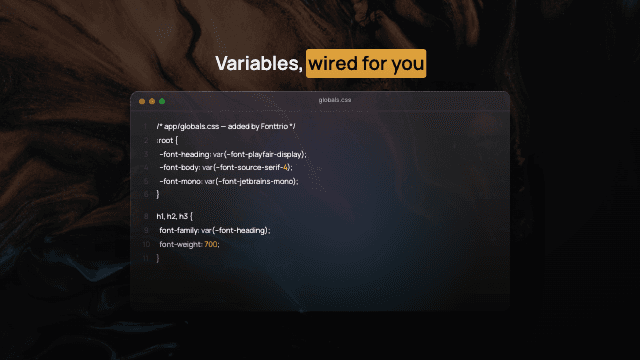
A type-forward spot for Fonttrio, the curated font-pairing registry for shadcn/ui. Three pain questions enter via shared-axis-z, a 'Three fonts.' hook lands, then the editorial pairing reveals its three roles — Playfair Display, Source Serif 4, and JetBrains Mono — each rendered in its real typeface. A terminal-cursor-zoom install (npx shadcn add @fonttrio/editorial), a GlassCodeBlock of the generated CSS variables, a rolling-number count of 78 curated pairings, a specimen wall of 'Ag' across moods (editorial, bold, impact, clean), and an outro with the trio mark, the Fonttrio wordmark set in Playfair Display, the tagline, and a copy-ready install pill.
render-sdk — One render API
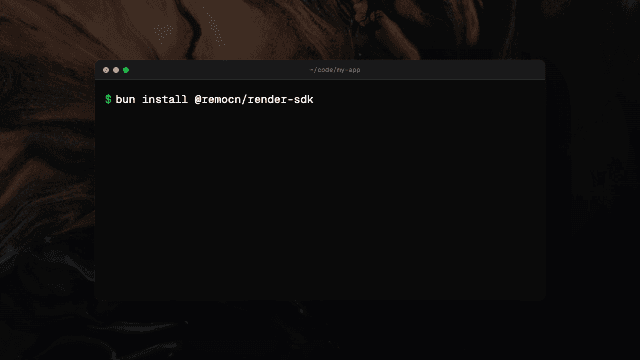
A launch spot for @remocn/render-sdk: three pain questions enter via shared-axis-z, a scale-down-fade 'Stop.' interrupts, then 'One API, different providers' leads into render + lambda adapter cards, a terminal-cursor-zoom install (bun install @remocn/render-sdk), a GlassCodeBlock code example, a logo-enter framework wall (Next.js, React, Remix, React Router), and an outro with a drawn-on box mark, the render-sdk wordmark, v1.0.0, and tagline.
Agent Skills — Claude Code makes the video
A meta product spot: Claude Code receives /remocn make a great demo video, thinks through the remocn skill, and 'produces' a polished remocn showcase — a zoomed terminal typing the install command, the component's code scanned top-to-bottom in a glass block, six component examples blurring in (checkbox, input, drawer, alert-dialog, select, sheet), GitHub stars, an X followers overview, white text dividers, and a closing wordmark.
Changelog — Faster site, stronger guards
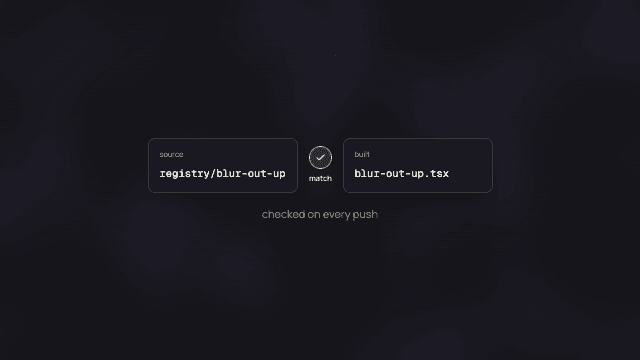
A changelog spot for the 2026-07-07 performance-and-guards update, in the shipped remocn.dev cinematic register — warm obsidian, one lime accent, Manrope 400, one quiet simplex-noise field. A Feature-Benefit Cascade on a trust throughline: hook 'copy-paste UI runs on trust' → the title 'Faster site, stronger guards' → players mount on scroll → the hero video counts down 18.5 to 4.7 MB → the registry drift guard (a source↔build compare panel with a lime match check, every push) → a CI checklist assembling (lint, typecheck, tests, drift guard) → render-API hardening (trusted IPs, capped queues, allowlisted avatars) → a line-by-line trust climax (faster to load / safe to render / always in sync) → the introducing-remocn smoke-ring outro assembling the new R mark into the Remocn wordmark over remocn.dev. Section boundaries use a new registry transition, sync-snap: the incoming scene arrives as an offset ghost and snaps into alignment — drift locking into sync, mirroring the drift guard. No letter-spacing, uppercase, badges, pulsing or install pills; no swirl or ripple.
Typography — New Text Animations
A changelog spot for the 2026-06-23 typography-wave (18 new text animations), rebuilt in the shipped remocn.dev cinematic register — warm obsidian, one lime accent, Manrope 400, one quiet simplex-noise field carrying the whole video. The product demonstrates itself: every effect is introduced by animating its own name, split into the changelog's own two groups (ten entrances, eight exits/swaps) over a still NN/18 counter. Hook 'text is most of what a demo video says' → the count → the two self-naming montages → the differentiator (built on interpolate and spring, not CSS keyframes — they seek correctly and render identically) → a line-by-line value block → one typed npx shadcn add → the introducing-remocn smoke-ring outro assembling the new R mark into the Remocn wordmark over remocn.dev. Section boundaries use a new registry transition, caret-wipe: a lime text caret sweeps across the frame, typing the incoming scene in as it consumes the outgoing one. No letter-spacing, uppercase, badges, pulsing or install pills; no swirl or ripple.
Batchwork — Unified Batch API
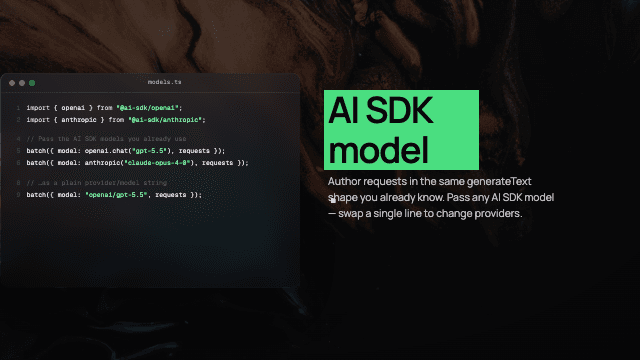
A product spot for batchwork: one batch API for every AI provider, with glass code windows and marker highlights.
Changelog — New Chat Components
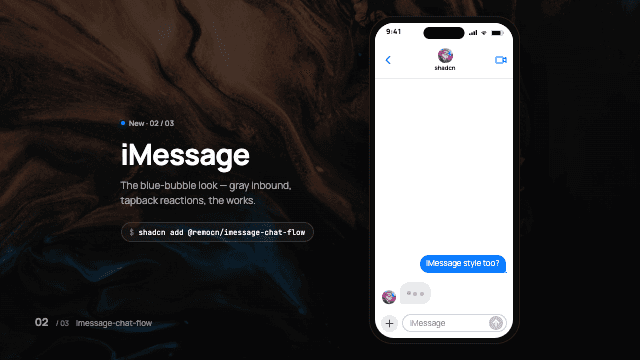
A changelog spot for remocn's chat primitives in the obsidian house style — the same conversation replayed through chat-flow, iMessage and Telegram skins in a live phone frame, joined by the new bubble-bloom transition. Built from message-bubble + typing-indicator, one message API across all three skins.
Changelog — Rolling Numbers
A remocn v2.0.6 changelog spot showcasing the rolling-number animation.
Signup Flow
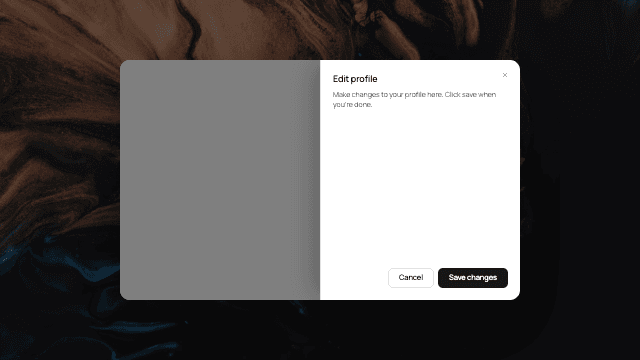
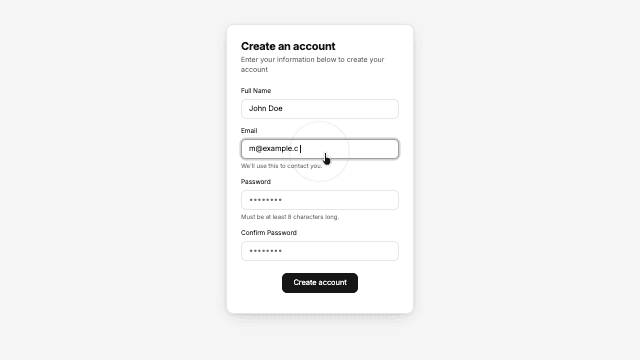
An animated signup form flow built from remocn primitives.